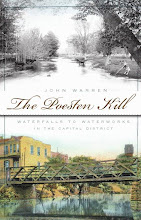
John Warren (yours truly) has written the first history
Showing posts with label Events. Show all posts
Showing posts with label Events. Show all posts
Sunday, October 18, 2009
Rensselear County Historical Society Talk Thursday


Monday, July 6, 2009
Hudson River Dinner Cruise with Len Tantillo
 The Rensselaer County Historical Society (RCHS) will host the Times Union's 2009 Best Local Artist and Historian Len Tantillo for a dinner cruise on board the Captain JP II, leaving from Troy and sailing south to the Hudson-Athens Lighthouse. The event will take place on Sunday, July 19th, 2009 from 3 to 9PM; the cost is $85.00 per person for RCHS Members, $95.00 per person for non-menbers.
Tantillo, a noted Hudson River artist and historian, will narrate the often complex relationship that Henry Hudson had with his crew and the various Indian tribes that they encountered on their trips ashore. Scenic highlights and historic landmarks will be pointed out on the west and east side of the river including Papskanee Island in the Town of Schodack, the reputed place that Hudson dropped anchor and traded with the Mahican Indians. Guests will also be treated to a dinner buffet of salmon, roast turkey and prime rib along with a array of vegetables and desserts.
Guests will board at 3PM at the foot of State Street in Troy. Free parking is available dockside. The boat will leave promptly at 3:30 and return to the Troy dock at approximately 9PM.
To purchase tickets for the trip, please visit www.rchsonline.org/tickets.htmlor call (518) 272-7232, extension 12.
Photo: "A View of Troy, New York, 1847" by Len Tantillo - "This painting of Troy, New York, depicts the Hudson River city as it might have appeared in the mid 19th century. The image was based on a number of period drawings, photographs and maps from the collection of the Rensselaer County Historical Society"
Monday, April 20, 2009
Help Out The Rensselaer County Historical Society
 Since the news broke in early March that the Rensselaer County Historical Society (RCHS) was in serious financial trouble, there has been an outpouring of support from the community. RCHS board and staff have been working hard to make the most of many offers and come up with a plan to "Keep the Lights On and the History Alive."
For the first public event of this campaign, ticket proceeds from the Saturday, April 25, 2009 preview of the New York State Theatre Institute's production of Philip Barry's timeless comedy, "The Philadelphia Story" will be donated to RCHS to help our 82-year-old organization in the fight to stay open.
Patricia Di Benedetto Snyder, the theater's producing artistic director, made this generous offer to the organization shortly after RCHS announced that without significant and immediate support it will need to close its doors or greatly reduce public access. The celebrated comedy will play in an 8:00 pm performance on Saturday, April 25 at the Schacht Fine Arts Center of Russell Sage College in Troy.
Tickets benefiting RCHS are available for $30 (Friends of the Family), $50 (Wedding Party), and $100 (Honored Guests) levels. Ticket cost is tax-deductible, and additional donations are welcomed. Tickets may be purchased online or by calling (518) 272-7232, ext.12. All tickets will be held at the box office for pickup the night of the performance.
Friday, February 13, 2009
Threatened Churches of Troy
Here is an announcement from the Rensselaer County Historical Society about an upcoming event looking at the threatened churches of Troy:
Many of our downtown churches are threatened by declining attendance and the demands of maintaining historic structures.In Troy, the Roman Catholic Church plans to close six of the fourteen churches in Troy; two of the five Episcopal Churches are for sale, and others are also threatened. Unfortunately, many of the most threatened churches seem to be the oldest and most historic.
Architectural historian Ned Pratt will survey the important architecture and stained glass of these churches, and examine several examples of the adaptive reuse of historic Churches, including four in Troy itself.
Ned Pratt is a preservation consultant and President of the local chapter of the Society of Architectural Historians. He has an interest in the stained glass and architecture of area churches, and has given talks and tours of area churches and stained glass for the Hudson Mohawk Gateway, Hudson Valley Community College, the Sage colleges, Historic Albany, and for Oakwood Cemetery - to mention just a few.
Please note - due to the public interest in this talk, it has been moved from RCHS to the Bush Memorial Center at Russell Sage College. The Bush Center is an adaptive reuse of the former First Presbyterian Church and provides the perfect setting for this topic.
The event will be held Thursday, February 19, 2009, 5:30 - 7:30 pm at the Bush Memorial Center, Russell Sage College, First & Congress Streets, Troy.
Although there was an area of intensive social services centered on St. Mary’s Church that had grown at the base of Mount Ida north of the Poesten Kill, in the late 1800s there were few churches serving the area around the lower Poesten Kill. Between Washington Park and the Poesten Kill there was just two: Saint Jean Baptiste (St. John the Baptist) and St. Laurence; south of the Poesten Kill there was only St. Joseph’s. Saint Jeane Baptiste was a French speaking church that was organized in 1850 on Ferry Street; their church on Second Street, south of Adams was dedicated in 1869. St. Laurence’s Church was a German speaking Roman Catholic congregation. It was first organized at meetings at St. Mary’s Church and then for a year at Alexander Lutzelberger’s Billiard Hall on River Street; they met at the French church in 1869 and the following year began building their church on the southeast corner of Third and Jefferson streets.
Subscribe to:
Posts (Atom)