Sterling Goodenow noted the presence of “Mount Ida Falls” in his 1822 Topographical and Statistical Manual of the State of New-York. Horatio Gates Spafford’s 1824 Pocket Guide for Tourist and Traveler however, acknowledged Mount Olympus on the north side of Troy but of the Poesten Kill only noted that it was home to “Mills & c.” Mount Olympus became a regional attraction that was exploited at an early date. In 1823, W.D. Vanderheyden (by then most of the family had accepted the shortened spelling) built a large octagonal building on the highest point to accommodate sightseers and a walkway was built from the roadway below. The building included a concession that was staffed day and night and markers were installed to direct visitors to the views. The building was destroyed by fire in 1830.
Already however, some visitors were bemoaning the development on Mount Ida and beyond. A writer to the New York Commercial Advertiser in 1835 wrote that the “delightful situation” of Mount Ida had “been invaded” by houses and businesses over and below.
Monday, July 20, 2009
Mount Ida's Early Rival, Mount Olympus


Monday, July 13, 2009
de Laetsburgh, Later Known as t’Greynen Bosch (Greenbush)
 Culturally, the Poesten Kill might seem to be just one of the many westward-flowing streams that drain Rensselaer County, a county dominated by waterways that divide rolling hills. On close examination however, the Poesten Kill holds a special place.
Consider the earlier outlying farm built across from Fort Orange by 1632 on the south side of Mill Creek at de Laetsburgh, later known as t’greynen bosch (Greenbush, the pine woods) and is now within the Rensselaer city limits. Like the Poesten Kill it also had mills, homes, a brewery and tavern, and a Dutch Reformed church and parsonage.
A ferry was established there and later colonial soldiers were often mustered under the protective eye of the fort across the river. The ferry continued to be controlled by the Van Rensselaer family until the nineteenth century providing easy and regular transportation between the Greenbush and Albany.
So it was that Greenbush was settled before the Poesten Kill, but with its close association to Albany by ferry, it could hardly be described as frontier; The City of Rensselaer was once known as East Albany.
Saturday, July 11, 2009
Rensselaer Co. Historical Society Interim Director Resigns
 The Albany Times Union is reporting today that the beleaguered Rensselaer County Historical Society (RCHS) is losing the interim executive director, Rachel Tooker, less then six months after she took the post. Members of the organization, including Renssealer County Historian Kathy Sheehan, (who also serves as the society's Registrar) touted her as the leadership necessary to steer the non-profit back to solvency. She will be moving to California where her partner has taken a museum job.
In March, RCHS sent an e-mail warning of dire consequences for the society: "What may have seemed - even ten years ago - a reasonable endowment with sustainable cash reserves has now dwindled to the point where we are no longer able to pay our bills. Without an immediate and substantial infusion of funds (upwards of $150,000), it appears that we will be required to close our doors while we work to implement a prudent fiscal strategy." No communication with members, supporters, or the press suggested Tooker would be leaving before the Times Union's report today.
According to the Times Union, "Tooker said the historical society has charted a new course that will help it correct its financial difficulties. The New York Council of Nonprofits will provide managerial leadership for the historical society."
Monday, July 6, 2009
Hudson River Dinner Cruise with Len Tantillo
 The Rensselaer County Historical Society (RCHS) will host the Times Union's 2009 Best Local Artist and Historian Len Tantillo for a dinner cruise on board the Captain JP II, leaving from Troy and sailing south to the Hudson-Athens Lighthouse. The event will take place on Sunday, July 19th, 2009 from 3 to 9PM; the cost is $85.00 per person for RCHS Members, $95.00 per person for non-menbers.
Tantillo, a noted Hudson River artist and historian, will narrate the often complex relationship that Henry Hudson had with his crew and the various Indian tribes that they encountered on their trips ashore. Scenic highlights and historic landmarks will be pointed out on the west and east side of the river including Papskanee Island in the Town of Schodack, the reputed place that Hudson dropped anchor and traded with the Mahican Indians. Guests will also be treated to a dinner buffet of salmon, roast turkey and prime rib along with a array of vegetables and desserts.
Guests will board at 3PM at the foot of State Street in Troy. Free parking is available dockside. The boat will leave promptly at 3:30 and return to the Troy dock at approximately 9PM.
To purchase tickets for the trip, please visit www.rchsonline.org/tickets.htmlor call (518) 272-7232, extension 12.
Photo: "A View of Troy, New York, 1847" by Len Tantillo - "This painting of Troy, New York, depicts the Hudson River city as it might have appeared in the mid 19th century. The image was based on a number of period drawings, photographs and maps from the collection of the Rensselaer County Historical Society"
Monday, June 29, 2009
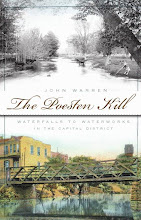
The First History of The Poesten Kill Due Soon
 The first detailed history of the Poesten Kill from the Petersburg Mountains to the Hudson River is due out in July. At the head of Hudson River navigation the mouth of the Poesten Kill was located at the eastern end of the Erie Canal, the southern end of the Champlain canal, and an important center of the very early Rensselaer & Saratoga and later Troy & Greenbush and New York Central railroads. The Poesten Kill was home to the first paper factory in Northern New York and for many years Troy rivaled Pittsburgh in iron and steel production. What really made life along the Poesten Kill so unique, however, was the diversity of products made there. Unlike other eastern urban areas, the Poesten Kill was home to producers of agriculture and forest products along with feed, flour, paper, plaster, paint, textiles, iron and steel products like stoves, valves, and wire – a substantial variety of consumer goods used along the kill and in the world beyond.
The Poesten Kill, will be published by The History Press. I'll be posting plenty of additional material here each week that didn't make the book, along with images, maps, and more. You can sign up to get the RSS Feed or get the posts by e-mail by entering your email address at right.
Monday, April 20, 2009
Help Out The Rensselaer County Historical Society
 Since the news broke in early March that the Rensselaer County Historical Society (RCHS) was in serious financial trouble, there has been an outpouring of support from the community. RCHS board and staff have been working hard to make the most of many offers and come up with a plan to "Keep the Lights On and the History Alive."
For the first public event of this campaign, ticket proceeds from the Saturday, April 25, 2009 preview of the New York State Theatre Institute's production of Philip Barry's timeless comedy, "The Philadelphia Story" will be donated to RCHS to help our 82-year-old organization in the fight to stay open.
Patricia Di Benedetto Snyder, the theater's producing artistic director, made this generous offer to the organization shortly after RCHS announced that without significant and immediate support it will need to close its doors or greatly reduce public access. The celebrated comedy will play in an 8:00 pm performance on Saturday, April 25 at the Schacht Fine Arts Center of Russell Sage College in Troy.
Tickets benefiting RCHS are available for $30 (Friends of the Family), $50 (Wedding Party), and $100 (Honored Guests) levels. Ticket cost is tax-deductible, and additional donations are welcomed. Tickets may be purchased online or by calling (518) 272-7232, ext.12. All tickets will be held at the box office for pickup the night of the performance.
Wednesday, March 11, 2009
Rensselaer County Historical Society May Close
 The Rensselaer County Historical Society has announced that they may be forced to close due to economic hardship. I will reprint here the message they sent:
We Need Your Help!
Keep the lights on and history alive!
To our members and friends,
As you may have read in [yesterday's] Times Union, RCHS is currently experiencing severe financial difficulty. The organization been running annual deficits for several years, and despite special efforts, the situation has now become critical. In a matter of weeks RCHS will no longer have funds available to meet its basic operating needs. What may have seemed - even ten years ago - a reasonable endowment with sustainable cash reserves has now dwindled to the point where we are no longer able to pay our bills. Without an immediate and substantial infusion of funds (upwards of $150,000), it appears that we will be required to close our doors while we work to implement a prudent fiscal strategy.
If we must close,
· our loyal and hardworking staff will be furloughed. Together these professionals have over 74 years of service to our community.
· exciting new educational initiatives, popular public programs, and long-planned exhibits would cease or be cancelled. The loss to our community - both economically and psychologically - would be incalculable. RCHS collections hold over 60,000 items of decorative arts, furniture, paintings, and sculpture. None of these items would remain available to the public. More importantly, an even greater number of documents relating to our past would be completely inaccessible. The utility bills alone for maintaining these collections are almost $6,000 a month.
· RCHS efforts as a major catalyst in highly visible efforts to use the historic fabric of our county to stimulate economic development will be curtailed. We hope to be able to continue serving - in fact inspiring - our community through these efforts.
We are beginning a public campaign to "keep the lights on and history alive!" As in the past, we are grateful for your active interest and suggestions regarding strategies to ensure RCHS's survival. We also urgently need your personal assistance in providing immediate financial support during this financial crisis.
Our plan is to take the next three to four months to develop - in partnership with our supporters - a new business plan for RCHS, designed to ensure its long-term sustainability. We are fortunate to have Rachel Tooker, a very experienced and energizing Transitional Executive leading this effort. The dedicated members of the RCHS board are prepared to join Rachel to discuss our finances and future plans in detail. Please give us a call if you have questions or suggestions for us.
In the meantime, here are some things you can do to help RCHS:
Help us to spread the word about RCHS and its positive impact on the community.
Distribute RCHS membership and program brochures to your clubs and community organizations.
Hold a brunch or get-together and make a group donation to RCHS.
Give an RCHS membership as a birthday present or gift to a new neighbor.
Volunteer to help with an RCHS program or project.
Send us your ideas for making RCHS sustainable and an even more valuable part of the community.